
Get ASO insights in your inbox.
Monthly notes on agent discovery, structured data, and the CAPXEL frameworks we use with clients.
If you’ve invested in a premium website, strong SEO, and consistent brand design, you feel visible.
But AI agents don’t “see” brands the way humans do.
In CAPXEL audits, the most common pattern is startling:
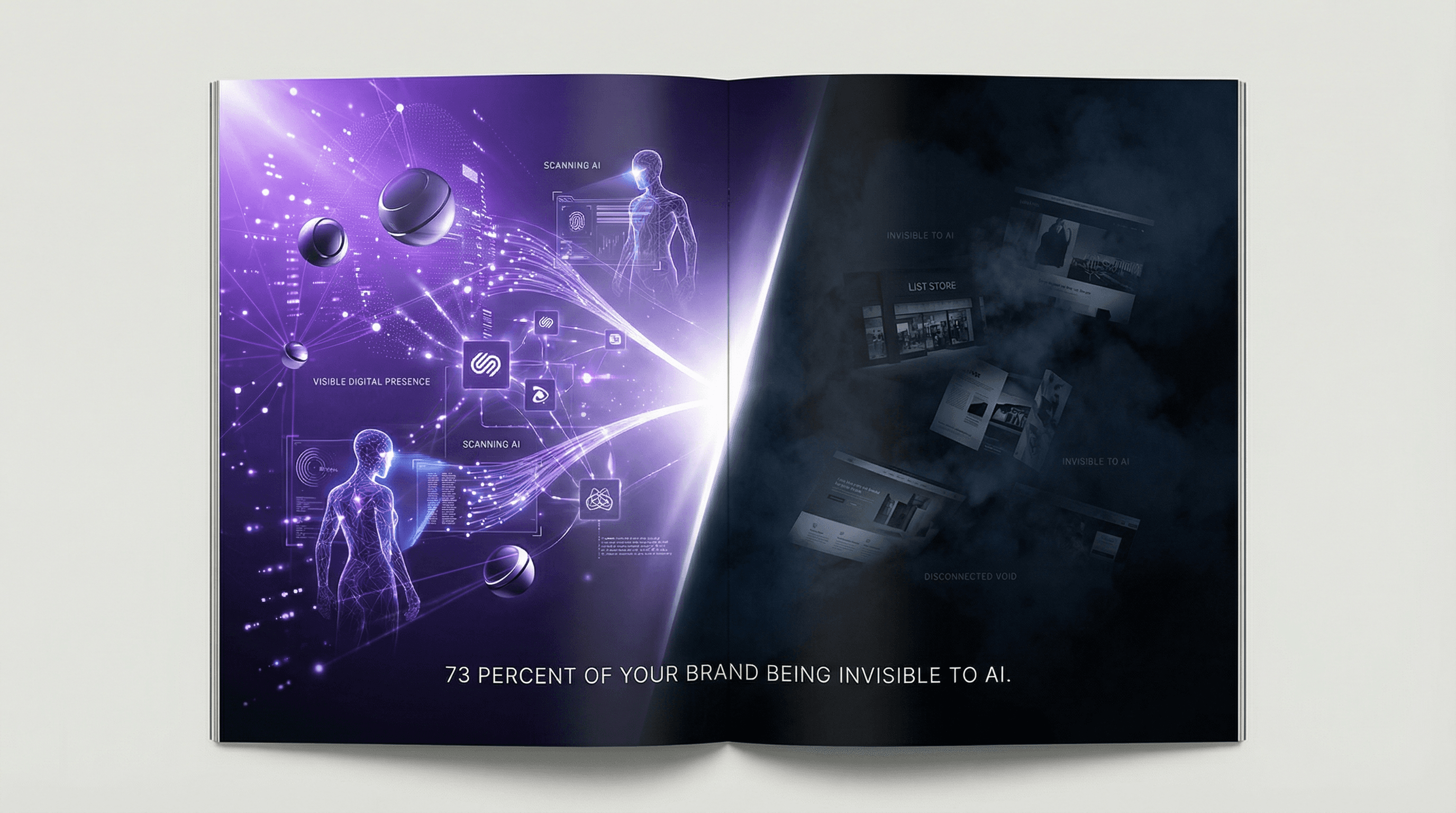
Roughly 73% of a brand’s decision-relevant information is either missing, unstructured, inconsistent, or inaccessible to automated agents.
That doesn’t mean your site is bad. It means the web is changing faster than the typical marketing stack.
This post breaks down the visibility gap—why it exists, what it looks like in practice, and how to close it using a measurable data layer.
The agent visibility gap (what “invisible” actually means)
When we say “invisible,” we don’t mean your homepage can’t be fetched.
We mean something more practical:
- the agent cannot confidently extract facts
- the agent cannot verify those facts across sources
- the agent cannot map facts to the user’s constraints
- the agent therefore omits you from the shortlist
In other words, you might be present on the web but absent from outcomes.
Why this is happening now
Two trends are converging:
1) Usage is shifting from search → assistants
Even without full autonomy, assistants have already changed behavior.
- ChatGPT became one of the fastest-growing consumer apps in history.
- Major platforms shipped AI assistants into operating systems, browsers, and productivity tools.
- Teams are adopting “AI copilots” for research, procurement, and evaluation.
The point isn’t the brand of assistant. The point is that information is increasingly consumed through machine-generated summaries.
If you want numbers that signal momentum, look at a few widely cited indicators:
- Enterprise adoption is accelerating. McKinsey’s global surveys have reported that a majority of companies are now experimenting with or using generative AI in at least one business function.
- Copilot-style tools are becoming standard. Major vendors are bundling AI assistants into productivity suites, which drives usage even when no one “decides to adopt” a separate tool.
- Agentic behavior is emerging. We’re seeing workflows move from “answer my question” to “complete the task,” especially in research, procurement, competitive intelligence, and sales enablement.
You don’t need every customer to be fully autonomous tomorrow. You only need enough decision-makers to rely on machine summaries for the economics to change.
2) The summaries are becoming actions
We’re moving from “tell me about X” to “do X for me.”
When the assistant becomes an agent, your brand must be machine-readable enough to survive the pipeline:
crawl → extract → verify → compare → decide → act
If any step fails, you’re invisible.
The four reasons brands disappear in agent workflows
Reason 1: Your site is optimized for persuasion, not extraction
Most modern sites are built for human attention:
- dynamic components
- heavy animation
- content split across tabs/accordions
- marketing copy that implies instead of states
Agents need the opposite:
- explicit statements
- stable structure
- scannable sections
- consistent labels
A human can infer that “enterprise-ready” implies SSO, SOC2, SLAs, etc.
An agent can’t assume. It needs those facts.
Reason 2: Your facts are scattered across the web
Agents cross-check.
They’ll look at:
- your website
- your LinkedIn
- directories
- reviews
- press
If your description differs across sources—different category words, different product names, different positioning—agents downgrade confidence.
In practice, this often happens because:
- marketing refreshes one channel but not others
- product evolves but listings don’t
- teams use different wording for the same offer
Reason 3: The “decision data” isn’t published
Agents need details that marketing teams frequently omit:
- who the product is for (ICP)
- what it integrates with
- pricing model (even a range)
- implementation steps
- constraints (regions, industries, minimum contract sizes)
Those details make comparison possible.
Without them, an agent can’t match you to the user’s request.
Reason 4: You don’t measure what agents are doing
This is the one that keeps the gap open.
If you only measure:
- page views
- rankings
- conversions
…you miss the new reality:
- agents fetch pages without rendering
- agents read the “wrong” version of content
- agents time out, get blocked, or follow broken paths
So invisibility can grow silently—even as traditional KPIs look fine.
What agents can reliably extract (and what they struggle with)
Here’s a pragmatic rule: agents do well with explicit text and structured signals.
They struggle with:
- meaning embedded in design
- “implicit” product descriptions
- content hidden behind UI interaction
- inconsistent naming across pages
This is why the same brand can look perfect to humans and ambiguous to machines.
How CAPXEL quantifies visibility (so this isn’t guesswork)
We treat agent visibility as a measurable system. Two CAPXEL products make that possible:
INSPEX — Customer intelligence as a visibility engine
INSPEX is not just analytics. It’s a way to understand how the market describes you and how agents might classify you.
In practice, INSPEX helps you:
- build a precise category + subcategory map
- identify your strongest differentiators in data (not opinions)
- detect inconsistencies across public sources
- generate a “canonical truth set” for your brand
That truth set becomes the basis for ASO.
Learn more: INSPEX
BEACON — AI crawler analytics + monitoring
BEACON is the measurement layer.
It monitors AI agent requests to your website and your ASO layer so you can answer:
- Which agents are crawling us?
- What endpoints do they request?
- Which pages do they prioritize?
- Are they timing out or failing to extract content?
- Are they seeing the updated version of our brand facts?
Without monitoring, you’re optimizing blind.
Learn more: BEACON
The “73% invisible” number: what it represents
That 73% isn’t a moral judgment. It’s a proxy for how much of your brand story cannot be used by an agent during decision-making.
It often includes:
- missing constraints (pricing, geography, compliance)
- unstructured proof (case studies without outcomes)
- unclear taxonomy (what exactly you sell)
- inconsistent identity across sources
- inaccessible content due to rendering or gating
When we fix those, the impact is not “more traffic.”
The impact is more inclusion in shortlists.
Closing the gap: the high-leverage fixes
If you want to reduce invisibility quickly, focus on these moves.
1) Publish a canonical “truth set”
Create a single source of truth for:
- organization identity
- products / services
- ICP + constraints
- differentiators
- proof
Then ensure every channel matches it.
2) Make the truth machine-readable
Add structured data and an AI-readable layer so extraction becomes deterministic.
This is where standards like LLM-LD and decision-oriented schemas matter.
3) Convert proof into facts
Agents prefer:
- metrics with context
- named deliverables
- clear timeframes
Instead of:
“We drive growth.”
Prefer:
“We increased qualified demo requests by 38% in 60 days by improving discovery across agentic search workflows.”
4) Instrument the system
Visibility isn’t a one-time project.
Once agents are crawling you, your job becomes:
- watch what they request
- watch what they fail to parse
- iterate the data layer
That’s how you stay visible.
The takeaway
The future isn’t just “AI content.”
It’s AI decisions.
Brands that win will be the brands that publish:
- clear facts
- consistent signals
- machine-readable structure
- monitoring that proves visibility
If you suspect you’re invisible, don’t guess.
Measure it, fix it, and then monitor it.
Next steps

Kalici focuses on the data layer behind AI visibility: how agents crawl, interpret, and act on brand signals across the web.
Get ASO insights in your inbox.
Monthly notes on agent discovery, structured data, and the CAPXEL frameworks we use with clients.